

Twenty Steps, Many Months, One Cloth
Clothing as craft. Craft as kinship.
20 Steps, Hundred Hands
Behind every length of cloth lies hundreds of pairs of hands and many months, and almost nothing in it was ever touched by a machine.
A finished Jamdani arrives looking effortless, the way a bird in flight looks effortless. It is not. In Ghornash, the looms live in the floors of homes. Sukanto Dey, a master weaver, coaxes the intricate Jamdani into being, while his wife Jaba spins the thread and weaves the plain ground from which everything else becomes possible. The knowledge in their hands has travelled down across generations, inherited, practised, and passed on again.
From Fibre to Finish
Phase One
The Thread
The fibre
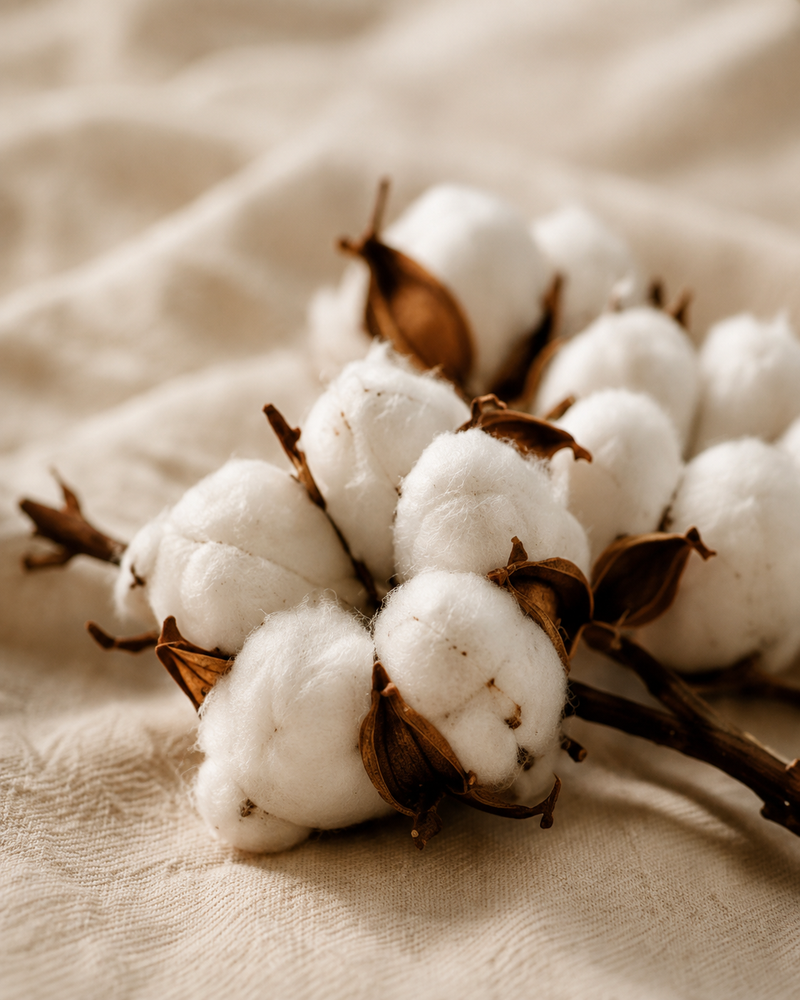
It begins in a field, not a studio. Raw cotton is picked by hand, boll by boll, then cleaned until only the long, fine staple remains, because Jamdani lives or dies on the fineness of its yarn. This stage rarely gets photographed, and yet it decides more than any other what the finished cloth will be capable of.
Carding and slivering
The cleaned cotton is combed, again and again, until every fibre lies the same way, coaxed into a soft, continuous rope called a sliver. A carder's hands decide, hour by hour, whether the yarn to come will be smooth or slubbed. There is no shortcut for that judgment, only years of practice.
Spinning on the charkha
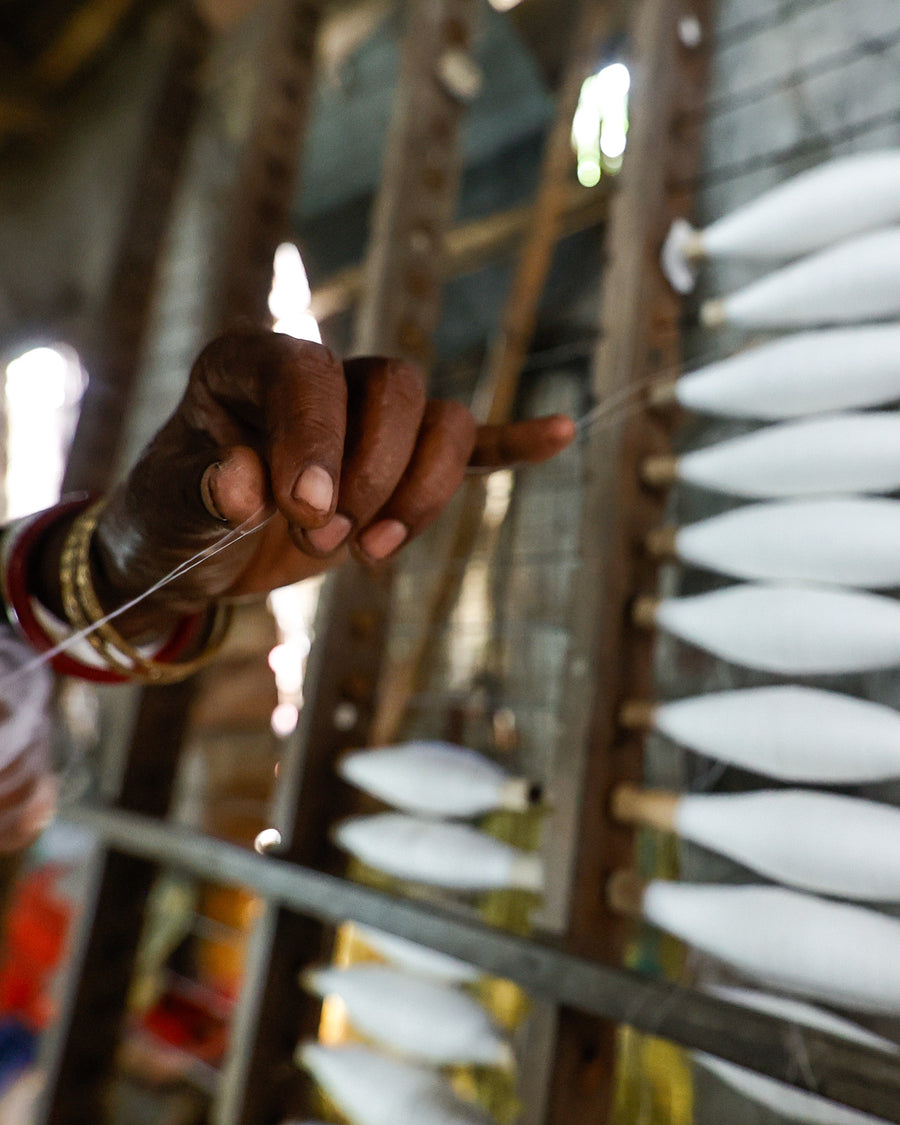
The sliver is spun into thread on the charkha, the wheel turned entirely by hand. In Ghornash, this is Jaba's wheel, turned in the in-between hours of a day that never quite stops. The yarn must be fine enough to carry a motif yet strong enough to last, a standard that can take weeks to master.
Twisting and reeling
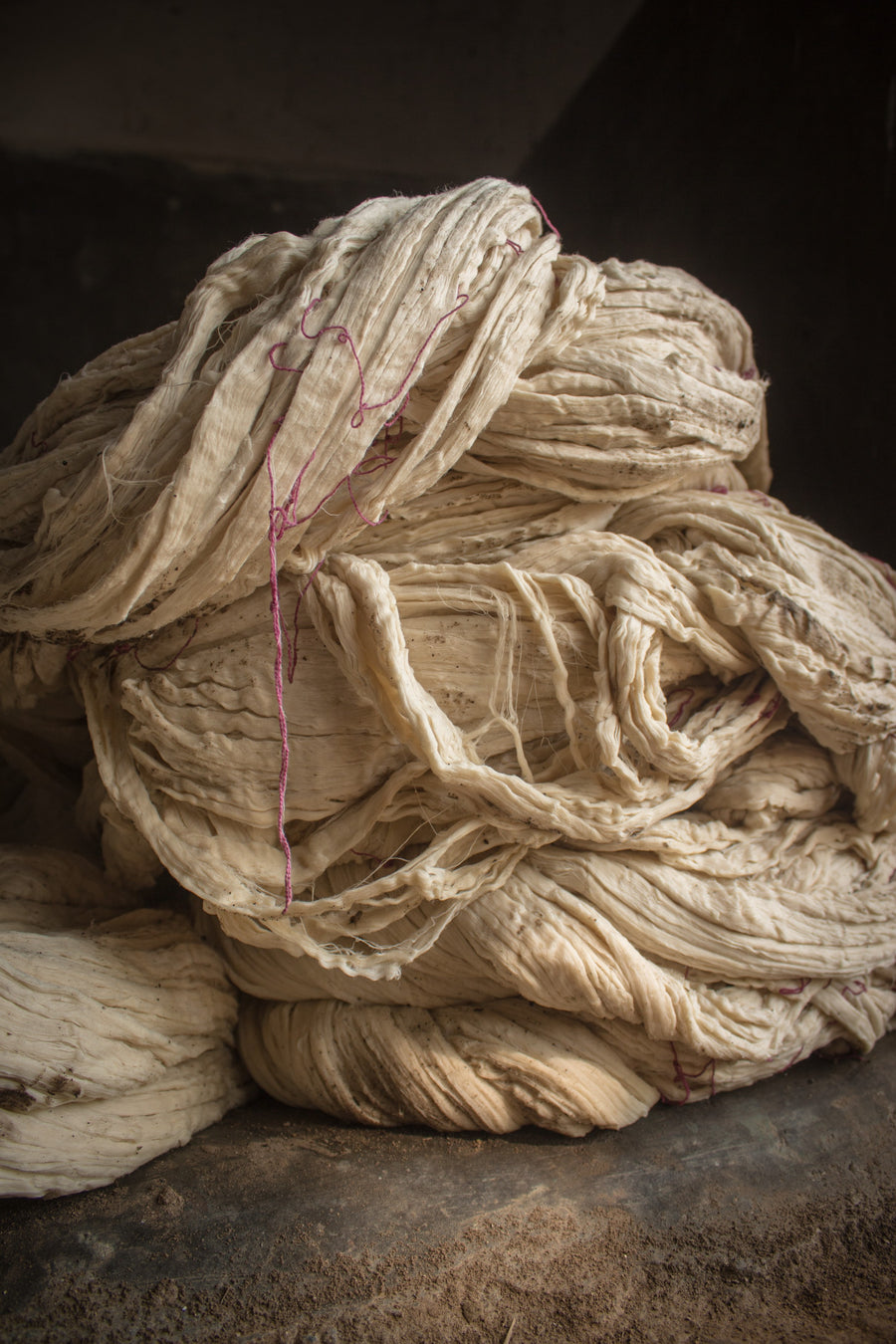
Once spun, the yarn is twisted and doubled into hanks, strong enough to hold tension on the loom without snapping. Every hank is checked by hand for evenness, because a flaw here becomes a flaw in the finished cloth. This stage takes days, and there is no room for shortcuts.
PHASE TWO
The Colour
Preparing the natural dyes
Colour here is cooked, not bought: indigo for blue, madder for red, pomegranate rind for gold. Each is brought to strength by eye, not recipe. Indigo asks the most patience of all, its blue built dip by dip, the depth simply a record of how many times the yarn has gone under and come up for air.
Dyeing the yarn
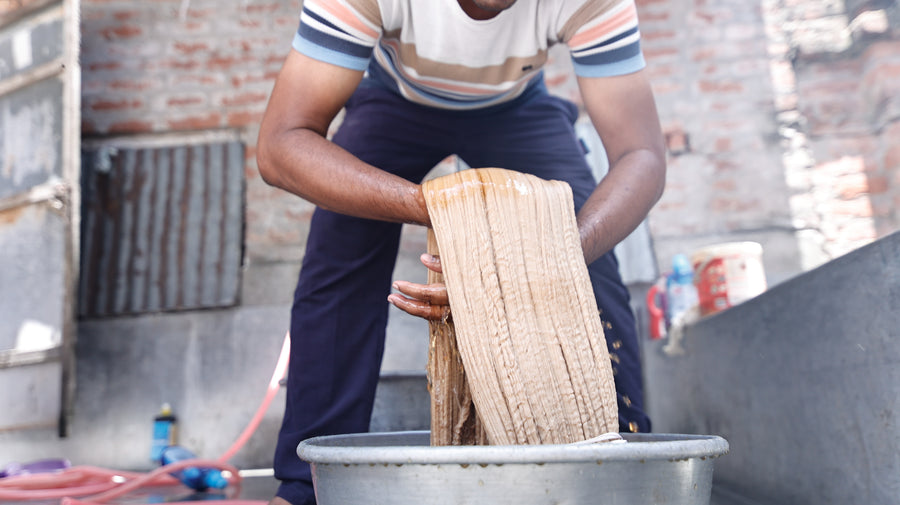
For a multicoloured cloth, separate batches are dyed to separate colours, planned around exactly where each thread will sit in the pattern still to come. The colour is fixed by hand over days of repeated immersion, never sealed in minutes by chemistry, and a dyer's stained hands are proof of the work.
Sun-drying
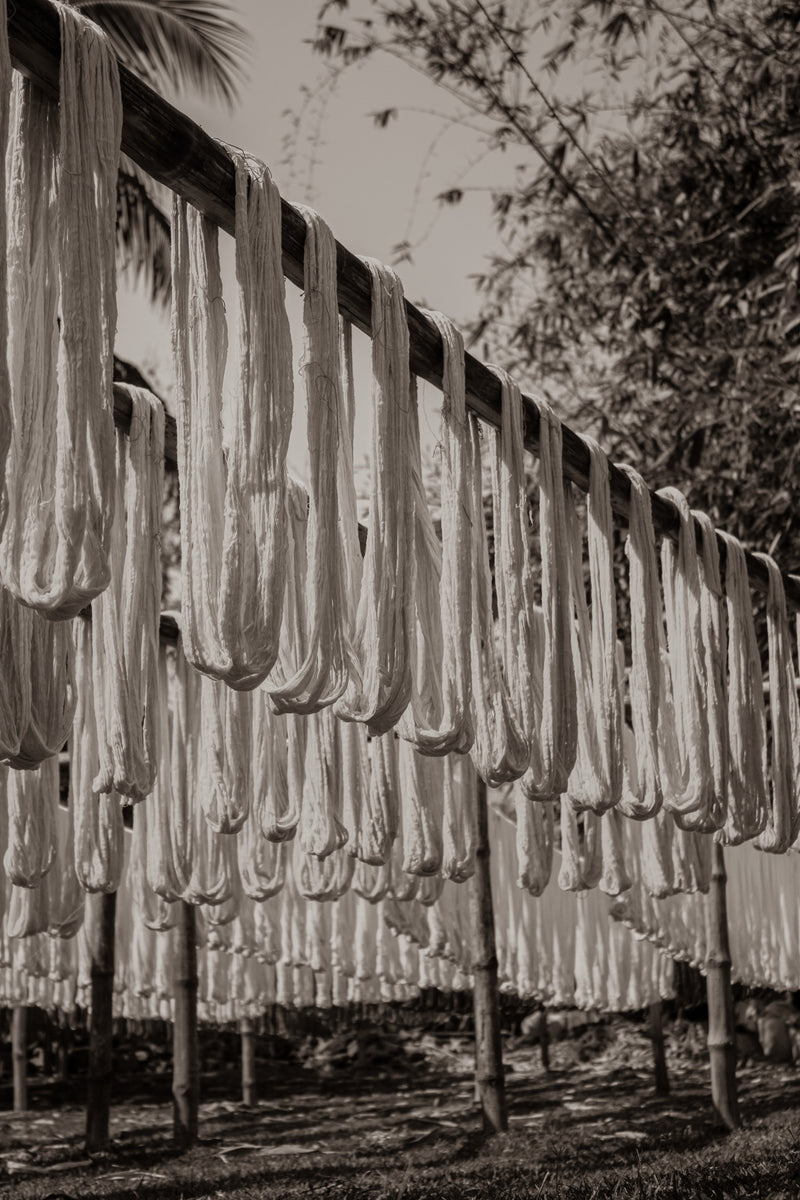
The dyed yarn is hung outside and left to the sun, because daylight sets and even a colour honestly. Hanks strung across Ghornash's courtyards, catching the light, are one of the village's quiet beauties. This stage is entirely weather-led. If the rain comes, the process simply waits.
PHASE THREE
Dressing the Loom
Sizing with rice starch
The dyed yarn is coated in a natural starch made from Kalma rice, a temporary armour that lets it survive the friction of weaving. It is never meant to last, washing out again in the cloth's first few washes, once it has done its quiet, essential job.
Winding bobbins and spools
The sized yarn is wound onto spools, sorted into warp, weft, and, for a multicoloured piece, individual small spools of colour, ready for the weaver's fingers. It looks like housekeeping. It is really forward planning, since a single motif may call for a dozen spools within arm's reach.
Warping (drumming)
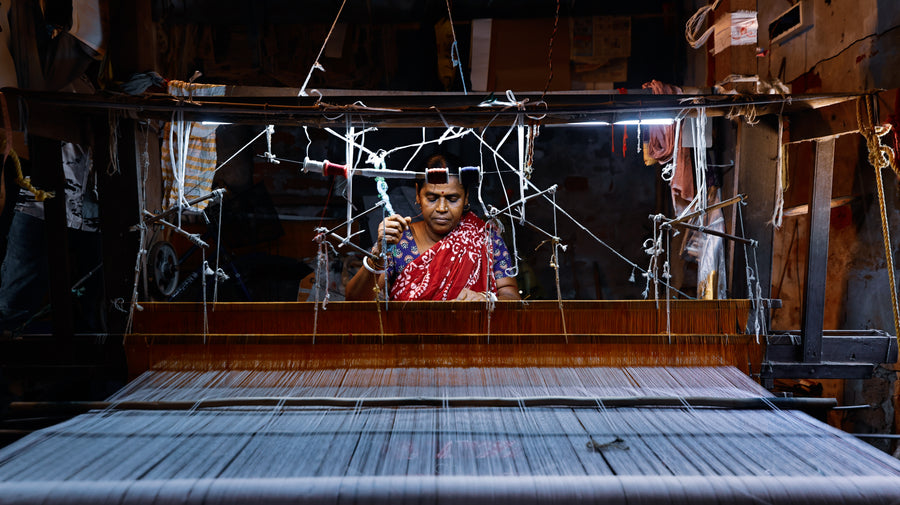
The warp is laid out on a large drum, measured to the cloth's exact length and width. For a fine Jamdani this can mean several thousand parallel threads, each positioned by hand so the ground will be even and true. A thread out of tension shows in every row woven afterward.
Healding and reeding
Every warp thread is drawn by hand through the eye of a heald and through the reed, one at a time. It is slow, eye-straining work, and a mistake here shows in the cloth forever. This is the quiet, unglamorous stage where the structure of the whole weave is truly decided.
Setting the pit loom
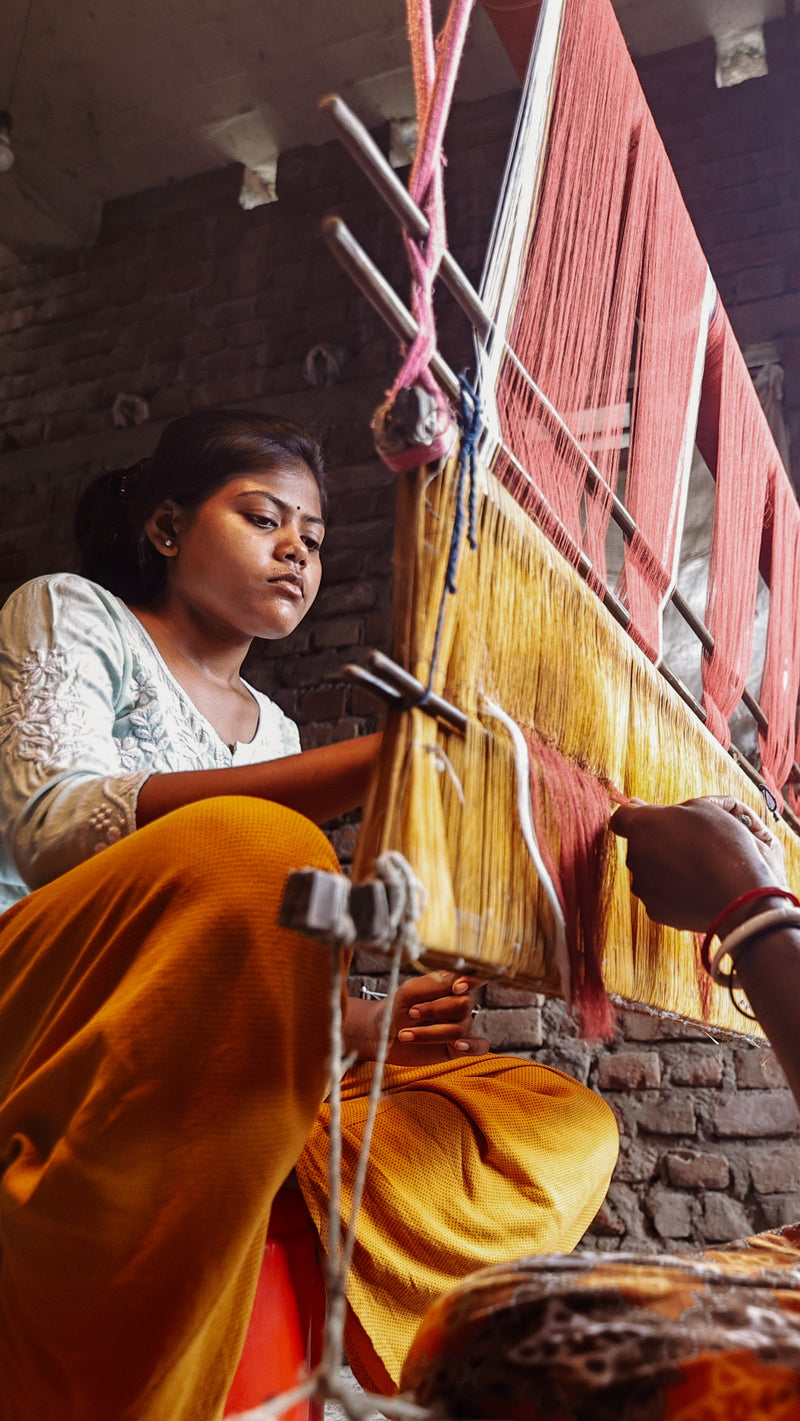
The dressed warp is mounted onto the traditional Bengal pit loom, sunk into the floor so the weaver sits level with the ground, the cloth rising to meet the hands. No electricity, no industrial frame. When the loom is set, weavers say the house finds its heartbeat again.
PHASE FOUR
The Weave
The design (naksha)
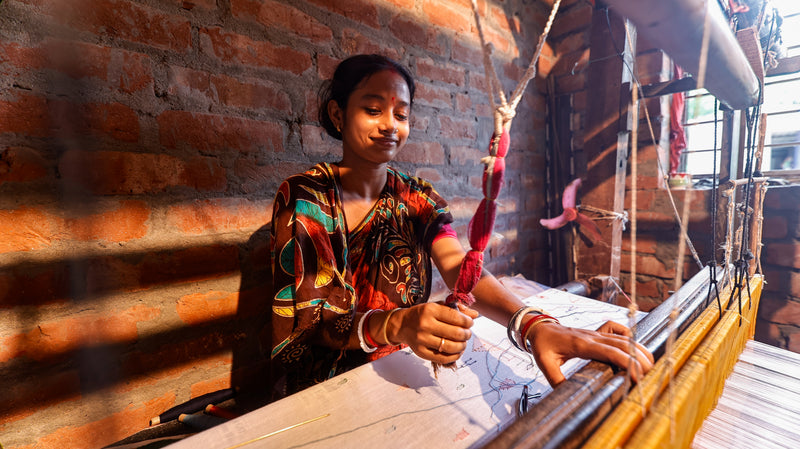
The motif is drawn first on graph paper and laid beneath the warp as a guide, though the most seasoned weavers barely look at it. They carry the pattern in memory, placed from years of repetition. The design is never sketched onto the cloth. It is built into it, thread by thread.
Weaving the ground
First comes the ground, the fine, sheer base woven row by row, in Ghornash quietly Jaba's mastery. Plain cloth cannot hide a single fault, so weaving it evenly, honestly, for the full length of a piece is its own act of skill, even if it rarely gets the credit.
The supplementary weft — the motifs
The heart of it, and the reason a Jamdani takes months. Each coloured motif is added by hand, often by two weavers side by side, lifting warp threads with a bamboo stick and threading colour through, spool by spool. Nothing is automated. A single fine, multicoloured Jamdani can live on the loom for up to a year.
PHASE FIVE
The Finish
Cutting from the loom
When the last motif is done, the cloth is cut free, relaxing for the first time after months of tension. The loom, once emptied, is dressed again almost immediately for the next piece to begin its own long journey.
Washing
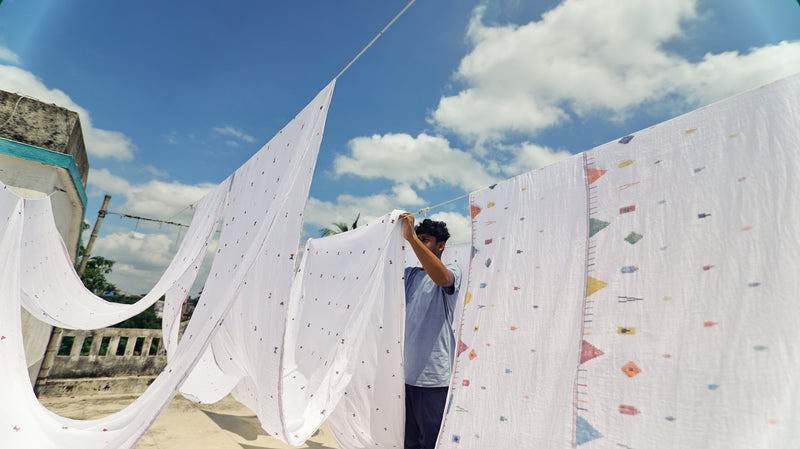
The cloth is washed to release the rice starch and any loose colour. As the sizing rinses away, the true drape appears, lighter and more fluid than it ever was on the loom, the first real hint of how the finished piece will feel.
Steaming and starching
The fabric is steamed to relax the fibres and settle the weave, giving Jamdani its calm, finished face and supple fall. A light starch may be reapplied, not to protect it this time, but simply to finish it, section by careful section.
Smoothing and pressing
Under heat, moisture and pressure, the cloth is smoothed into a soft, light-catching surface. This is the final easing of the fabric, the moment it stops being a project and becomes something you would actually want against your skin.
Inspection and naming
The cloth is checked by hand, against the light, for any flaw the eye can find. Only then is it ready. At Sahana, each piece is named for the hands that made it, numbered in its small run, and never restocked identically.
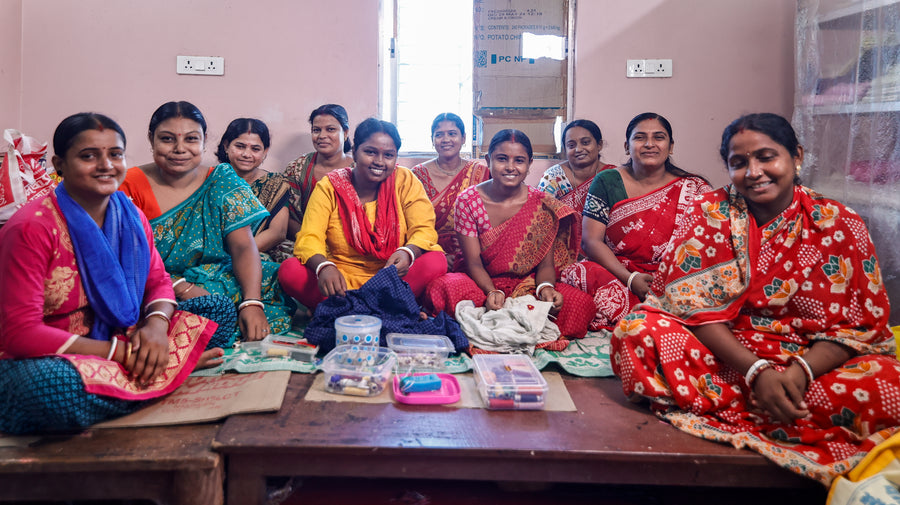
“Clothing as craft. Craft as kinship.”
Around twenty distinct hand processes, from a cotton boll to a finished cloth. Dozens of hands touch the same length before it ever reaches you, farmers, spinners, dyers, weavers, finishers. No machines involved in a single motif. Generations of knowledge, passed down unbroken, still living in the hands that made what you are holding.